The Prosperity Engine
“Every act of creation is first an act of destruction.” — Pablo Picasso

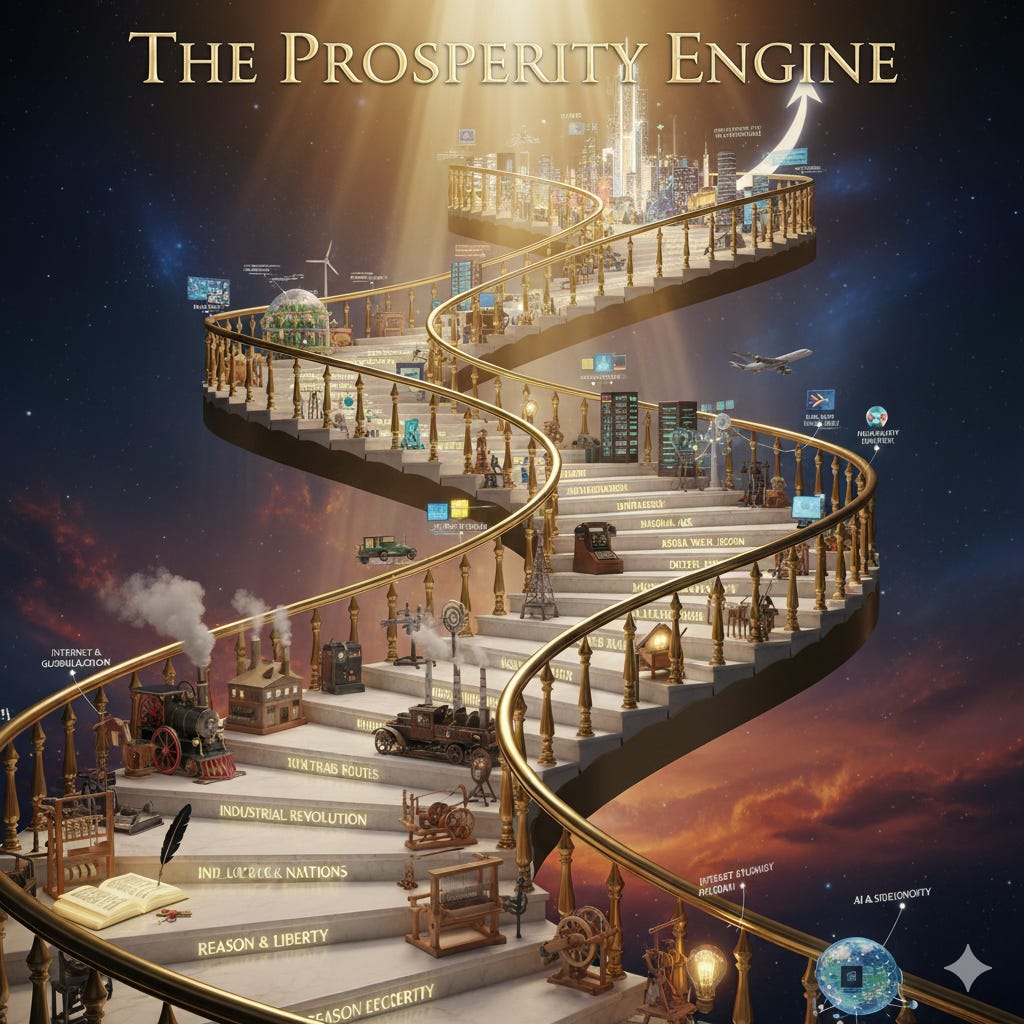
[The following is an excerpt from our Q3 2025 client letter.]
As bottom-up investors, we typically focus on fundamentals rather than macroeconomics. Yet, with the global economic order strained by trade wars and a rising tide of nationalism, we find ourselves turning to history to grasp the long-term implications.
Human progress is the story of Enlightenment values—reason, liberty, and science—unleashed by capitalism. The system’s genius lies in its ability to unlock human potential, empowering individuals to pursue their ambitions and capitalize on their unique talents.
When people are free to invent, invest, and spend in their own self-interest, they create powerful market signals. Billions of individual decisions determine what gets made and what fades away. This process mirrors biological evolution: useful innovations reward their creators, displace inferior alternatives, and propel society forward. It is the invisible hand and creative destruction working in tandem.
For millennia, humanity endured a grueling existence rooted in subsistence farming. The Industrial Revolution, fueled by scientific discovery and cumulative knowledge, marked the inflection point. An explosion of ingenuity has since given us everything from the steam engine to artificial intelligence. The result? The average person today enjoys a quality of life unimaginable to even the wealthiest robber baron of the Gilded Age.

China’s modern economic miracle was born from catastrophe. After decades of famine and stagnation under a failed ideology, Deng Xiaoping’s free-market reforms in the late 1970s unleashed a wave of prosperity that has lifted over 800 million people from extreme poverty—an unprecedented achievement in reducing human suffering.

For capitalism to truly work its magic, certain conditions need to be in place. First, the rule of law (the protection of private property rights and the equal application of the law) is required to create a stable environment for businesses and individuals. When the rules of the game are constantly changing or are dictated by government fiat, capital remains unspent and migrates to where it is welcomed. Had China’s reforms gone further to include the rule of law, its economic miracle would have been even more impressive.
Another essential ingredient is the freedom to innovate and fail. Governments should avoid the temptation to pick winners and interfere with market signals. Governments serve their citizens’ interests best when they focus on addressing market shortcomings through regulation, taxation, redistribution, and matters of national security or common good (e.g., infrastructure, education).
When governments abandon this role in favour of heavy-handed intervention, it results in inefficiency, misallocated resources, and slower growth. Europe, with its dirigiste policies, has perfected this model. It may be surprising to learn that the average European is less prosperous than the average resident of Mississippi, America’s poorest state. As you can see in the graphic (above right) (3), on this metric, Canada doesn’t fare much better.

State-directed economies are corrosive for a more fundamental reason: they breed a culture of corruption. When success depends on political favour rather than merit, private interests inevitably seek to bribe and influence those in power. This tragic satellite image of the Korean Peninsula at night illustrates what works and what doesn’t.

The people of these two sister nations share the same heritage and potential. Yet their fates could not be more different. One nation embraced a market system that allowed its citizens to flourish. The other is controlled by a despotic family that sacrifices its people’s well-being to maintain its grip on power, plunging an entire country into literal and figurative darkness.
Capitalism’s power is unlocked through specialization and comparative advantage, which requires the free trade of goods and services. While this system lowers costs for everyone, it inevitably creates winners and losers. This is the inherent social contract of free trade: to remain politically viable, the immense value it creates must be shared, by supporting the displaced through redistribution and retraining. If that social contract is broken, demagogues will harness the resulting frustration to seize power and wealth for themselves and their cronies.
The case for free trade, however, extends beyond prosperity. Critics who attack it are dismantling more than just an engine of wealth; they are undermining a powerful force for peace. When nations trade, their economies become intertwined, dramatically raising the cost of war. After centuries of bloodshed, Europe—the central battleground for two world wars—was rebuilt on this very principle. The economic integration that created the European Union has resulted in the longest period of sustained peace in the continent’s modern history.

With the last world war having faded from living memory, we risk forgetting that conflict is innate to every species, including our own. Centuries of warfare offer a clear lesson: the surest path to peace is shared prosperity, built on trade. Those who fail to learn from the past are doomed to repeat it.
Equally concerning is the renewed appeal of socialism, particularly among younger generations grappling with economic insecurity (higher unemployment, housing affordability). We want to introduce them to our friends Bogumil and Vitaliy, who grew up behind the Iron Curtain and now live in America. They both lived through the privations of the Soviet Union and are aghast at the romanticization of their former lives. While we are sympathetic to young people’s frustrations, history has delivered a clear verdict on this debate. To paraphrase Sir Winston Churchill:
Capitalism is the worst form of economic system except for all those other forms that have been tried. — GreensKeeper
One of Democracy’s advantages is its self-correcting mechanism: every few years, citizens can peacefully vote out their leaders when a change is needed. Autocracy, in addition to violating a fundamental law of nature—the universal desire for freedom— is a high-stakes economic gamble. It may occasionally produce a philosopher-king like Marcus Aurelius, but it offers no safety valve when a tyrant like Caligula holds rule. Free and fair elections by an informed citizenry are an important element in the story of human progress.
Yet the liberal world order, which has produced unprecedented prosperity since World War II, is starting to fray. We are witnessing a rising tide of nationalist governments run by strongmen spouting anti-immigrant and racist rhetoric. There is also an increasing tendency for Western governments to embrace state industrial policy.
Despite capitalism’s shortcomings—including the need to address income inequality through taxation and redistribution—there is no viable alternative if we wish to continue on the path of human progress. One must first create wealth before discussing how to redistribute it.
Postscript: For those not yet persuaded, just this morning, the 2025 Nobel Prize in Economics was awarded to three economists for their work explaining how innovation, free trade, and creative destruction drive economic growth.
The laureates’ work has stressed the importance of science-based innovation and a willingness to accept change, even when it has some negative consequences for particular businesses or groups of workers. We should not take progress for granted.
— Nobel Committee for the Prize in Economics
Oh Canada
Closer to home, there has been a clear and accelerating divergence of the Canadian economy from that of our larger neighbour to the south. Canadians and Americans are equally talented and educated. But through a series of poor policy choices (interprovincial trade barriers, excessive immigration), we are stifling our country’s potential. We would also argue that Canada’s protectionist attitude has played a part.

Canada is the land of oligopolies (banking, telecom, airlines, supermarkets) and quotas (dairy, poultry). Our experience trying to move US currency between two Canadian banks this past week was comically painful. Protected industries in Canada are not just trade irritants to our trading partners; they are bad for Canadians. Industry concentration and protectionist measures hurt every Canadian, especially the poor, who pay disproportionately more for basic goods when filling up their shopping baskets.
This retreat into protectionism betrays our own legacy. We are a nation of innovators who gave the world the telephone, insulin, and basketball. We are an educated, peaceful country blessed with abundant resources and favorable geography. Canada’s national balance sheet is in great shape due to decades of fiscal discipline. Government policy should be driven by the courage of what Canada has to offer the world, not by a fear of competition.
While Canada must always stand firm against unfair treatment from any nation, our default stance should be one of openness. We shouldn’t fear a level playing field; we should compete on it, confident in our ability to export Canadian goods and services to the rest of the world.
Let’s encourage the government to get out of the business of running the economy and back to its central role: ensuring the rules are transparent, fair, and applied equally to everyone. It’s time to dismantle the barriers and protectionist policies that shield politically connected industries at the expense of everyone else. When other nations mistreat us, we must respond decisively. Otherwise, we should let the prosperity engine work its magic.
Embracing capitalism’s creative destruction improves our lot. But it does create dislocations, winners and losers. A just society should also be measured by how well it treats its less fortunate. We think that Canada deserves high marks on this front.
Canada gets many things right, and we are proud and blessed to live in this wonderful country. By making a few astute policy changes—choosing courage over fear and competition over protectionism—we can unlock an even brighter future for all Canadians.
Happy Thanksgiving!